

The Heartwoods of Tir na Skiva
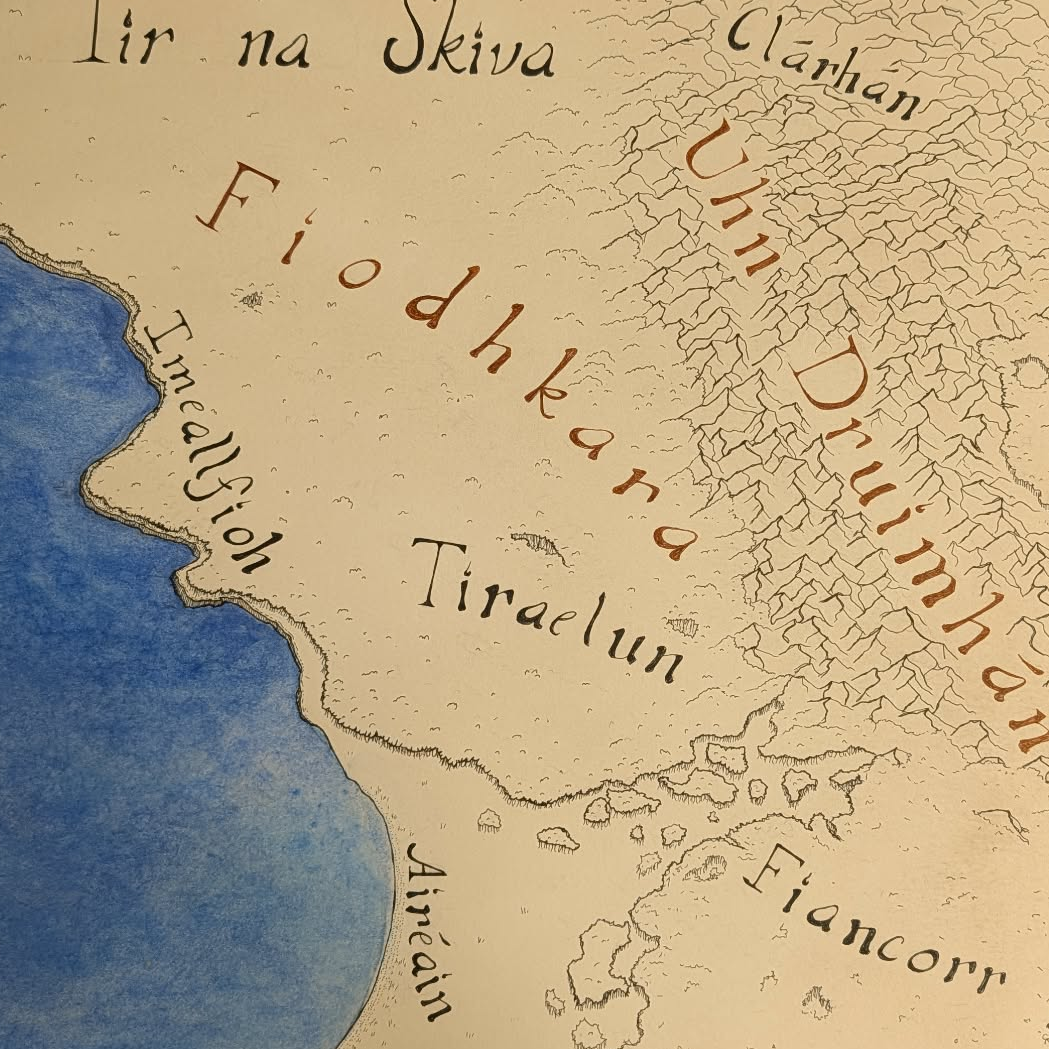
Collected and Recorded by Lucien Harow, Fellow of the Royal Society of Antiquities
There is a peculiar difficulty in attempting to map a land that no longer exists. Not vanished, precisely; no, the fae are quick to correct me whenever I use that word, but altered beyond retrieval. Torn open. Entangled with our own world so completely that memory and geography now cling to one another like roots beneath soil.
And yet, despite the centuries that have passed since the Shattering, the fae still speak of Tir na Skiva not as a kingdom lost, but as a homeland interrupted.
I have now spent nearly eleven years gathering accounts from fae dignitaries, artisans, wanderers, Root-Singers, and once (after a considerable amount of wine and patience, I might add) from one member of the Willow Court herself. Their recollections differ wildly in places. Distances change. Rivers alter direction. Entire groves appear and vanish depending upon who tells the story.
But there is one region every account returns to eventually: the forest. Not a forest. But The Forest. Fiodhkara.
Even now, the name is spoken differently than others. More slowly. With the strange care one might use when touching something sacred or terribly old. No fae I interviewed ever described Fiodhkara as wilderness. Mortals often imagine ancient forests as untamed places; dangerous, chaotic, full of hidden teeth and hungering dark. But the fae remember it differently. To them, Fiodhkara is not wild, it is attentive.
One Root-Singer described it to me as follows:
“You must understand, Archivist… the forest was not watching us. Watching implies suspicion. Fiodhkara already knew us. It remembered us before we arrived.”
This distinction, while deeply unhelpful cartographically, was repeated often enough that I eventually ceased arguing the point.
By all accounts, Fiodhkara dominated most of Tir na Skiva. It was not divided by roads, kingdoms, or borders, because such things appear to have held little meaning among the elder fae. The forest simply changed gradually around those who traveled through it: thinning near stone, softening near water, bending before wind and coastlines without ever truly ending.
The fae insist the forest possessed memory… but they insist they do not mean metaphorically.
Several described pathways that appeared only for those expected, trees that subtly altered their growth over decades to accommodate dwellings, and streams that “remembered grief,” though none could explain precisely what this meant. One metalsinger spent nearly an hour attempting to describe the sensation of walking through Fiodhkara after an argument, insisting the forest somehow held tension differently until reconciliation had occurred.
I confess I am uncertain whether this reflects magic, culture, or nostalgia. Perhaps all three.
The deeper regions of the forest were said to glow with a constant twilight illumination even beneath the densest canopy. Not bright enough to banish shadow entirely, but sufficient that no traveler ever felt truly blind. Many fae recall this light more vividly than the sun itself.
“The air shone,” one elderly seamstress told me simply, becoming unexpectedly tearful afterward.
What strikes me most, however, is how the fae describe silence there.
Mortals think of silence as emptiness, the fae do not. Again and again, I encountered variations of the same phrase:
“Silence in Fiodhkara was never absence. Only listening.”
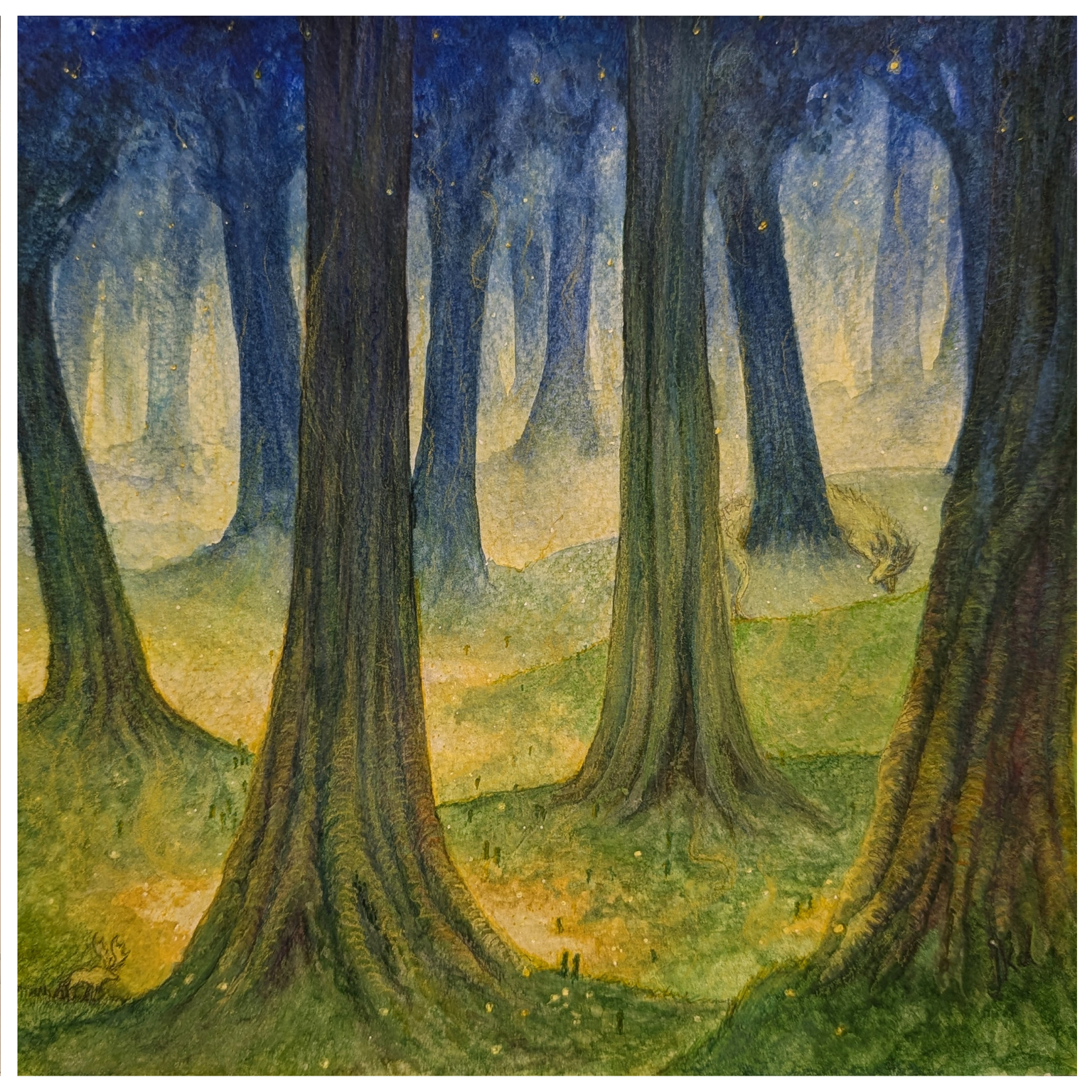
This belief appears to culminate within the region known as Tiraelun; the Elder Grove, or Heartwood as some modern poets now call it, though several fae reacted to that title with visible irritation.
Unlike the broader reaches of Fiodhkara, Tiraelun is spoken of almost cautiously. I was warned repeatedly that no map could truly depict it, because one did not “arrive” in Tiraelun in any ordinary sense. Rather, the forest permitted recognition, and even entrance.
The oldest trees in Tir na Skiva reportedly stood there: vast interwoven giants whose roots formed bridges and whose branches carried entire pathways high above the forest floor. Yet none who described these things spoke with grandeur. Reverence, yes, but never spectacle.
One former court musician explained:
“Tiraelun was not impressive in the way mortal cathedrals are impressive. It did not seek admiration. It merely continued existing until you understood your own smallness beside it.”
I find that sentence has lingered unpleasantly with me since hearing it.
Accounts of Tiraelun grow stranger the further inward one goes. Sound reportedly diminished toward its center; not abruptly, but gently, until even birds and running water seemed reluctant to disturb the quiet. Yet none who entered described fear… only stillness.
The Elders are deeply associated with this place. It is said important knowledge was rarely written there, only remembered communally. Several fae suggested memory itself behaved differently beneath those boughs, though none could adequately explain how.
One archivist of the Willow Court laughed softly when I pressed him for specifics and replied:
“You are a mortal, Mr. Harow. You preserve things because they vanish. We remembered because, in Tiraelun, forgetting felt impossible.”
I admit there are moments during these interviews where I begin to understand why some mortals resent the fae. Not for their magic, nor their beauty, but for the unbearable scale of what they lost, perhaps for what we never had at all.
However, I have learned that not all regions of the Heartwoods were peaceful in the same way.
Far to the northeast, pressed against the foothills of Uhn Druimhán, lay Scáihain: a region spoken of with noticeable hesitation by nearly every fae I questioned.
Where Fiodhkara remembered and Tiraelun listened, the fae say Scáihain withdrew.
Even its descriptions feel dimmer.
Trees grew closer together there, branches interwoven so densely that light arrived muted and diffuse, as though filtered through water. Voices carried poorly. Footsteps vanished almost immediately into the hush.
One traveling apothecary told me:
“Scáihain was kind, but not welcoming. There is a difference.”
The region appears to have become particularly significant during the earliest years of the Diminishing and curiously, every fae who spoke of Scáihain lowered their voice while doing so.
Not from fear, I suspect, but from respect, or perhaps guilt?
One Root-Singer finally told me:
“Scáihain did not hide people, Archivist. It hid pain. There are places even forests wish to protect.”
He then proceeded to explain that there are rumours that when the last inhabitant eventually departed the grove, the clearing he occupied reportedly dissolved into mist and shadow soon afterward. Some insist the place still exists. Others claim the forest intentionally unmade it. No two stories agree.
This, I am beginning to suspect, is the truest characteristic of Tir na Skiva: the land was never separate from the people remembering it. And memories, like forests, grow unevenly.
— Lucien Harow
Springtide, 1871