

Ravenna, Seer of the Willow Court
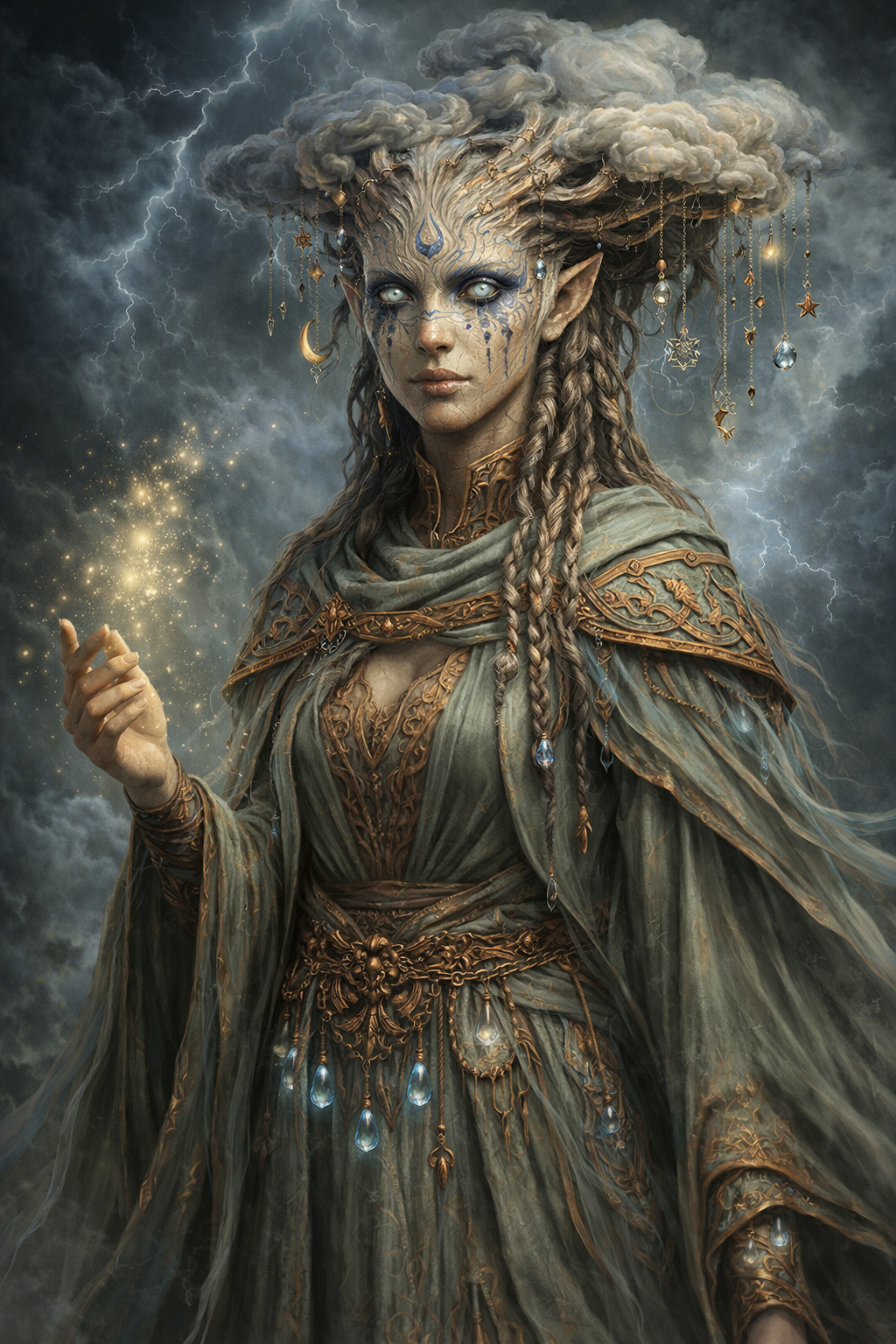
A Seer Born to the Storm
Ravenna was born beneath a sky already heavy with rain.
In the elder days of Tir na Skiva, storms were rare and meaningful things: not violent… but full of conversation and possibility; moments when sky and land spoke too loudly to ignore and magic moved in visible rhythm. A fae born during a storm was said to be marked indeed: attuned to motion, change, and the unseen pull of what had not yet come to pass.
From her earliest years, Ravenna listened to thunder as others listened to lullabies. Lightning did not frighten her, and she watched with a solemn stillness that unsettled even the most seasoned elder. As she grew, she sought out the high places to watch as storms rolled in; standing alone on ridges and climbing high in trees when the air thickened with promise.
Thus her gift did not arrive as dreams or visions, but as movement.
The pendulum that would become her constant companion was found, or perhaps given – a shard of veined crystal caught in the crook of a lightning-struck branch – later bound in gold thread by her own careful hands. When she held it the world seemed to hesitate; awaiting instruction.
Ravenna did not proclaim futures. She listened for them.
Storms leaned toward her. Paths revealed their strain. Truth arrived scented faintly of spun sugar: sweetness crystallizing too quickly to last.
Yet there was one silence her Sight could never pierce: she could not read her own future. When she turned the pendulum inward, it stilled… as though the world refused to echo back to herself. No storm answered. No path revealed its source. The elders called it balance: a necessary blindness in one so attuned to what lay ahead, and reluctantly, Ravenna accepted it as such.
She learned to live without certainty of her own becoming, believing that knowing the futures of others was enough.
Aelthryn of the Quiet Current
Among those who moved easily through the liminal spaces of the realm was Aelthryn, a Wayfinder of the High Paths – another form of Seer – one whose magic was rooted not in time, but in passage.
Where Ravenna read futures, Aelthryn navigated the present in the moments just before it became the past. She walked storm-ridges, misted valleys, and crossings where magic ran thin; sensing when paths shifted or strained beneath unseen weight, marking safe passage for other fae who desired to walk between realms. They met often at thresholds.
What began as interdisciplinary alignment soon became affection, then something deeper. They did not hide their bond because it was forbidden, for it was not, but because it was theirs. Quiet moments between storms. Sheltered glades. High mountain overlooks before the rain.
Early in their love, they made a pact: They would never read one another’s futures. Aelthryn had asked it lightly, but with earnest eyes. To walk dangerous paths beneath the gaze of prophecy would turn courage into performance, choice into inevitability, and Ravenna understood at once: to love someone whose future you know with utmost certainty is not love, it is surveillance.
So they agreed. No Sight. No certainty. Only trust.
The Broken Oath
When the fae world began to falter, Ravenna felt it first as hesitation. Storms arrived out of season. Magic lost its rhythm. Her pendulum no longer answered cleanly. Fear – not tempered by foresight – crept into her heart. And in a moment of quiet panic, she broke the oath; she read Aelthryn’s future.
What she saw was fragmented: a tearing of paths… a fall… sorrow without cause… darkness without context. And because she could not see herself in any future, she assumed the shadow belonged to Aelthryn alone; assumed that loving her was the catalyst. She feared her attachment would bring ruin.
She did not confess.
She carried the knowledge in silence and convinced herself restraint was wisdom.
And yet that knowledge ate at her… it followed her in her waking and her sleep. It darkened her Sight and slowed her pendulum. It grew like a cancer upon her mind, and all the while Aelthryn did not see – could not see – and continued to plan their life together.
They had planned to formalize their love in a secret ceremony at a convergence of High Paths. Not to hide their bond, but to keep it untouched by spectacle; a binding witnessed only by sky and stone, and the gentle blending of realms.
But at the last moment, Ravenna could not bring herself to go. She believed her absence would undo prophecy; but instead, it fulfilled it.
Aelthryn waited for her, long beyond when it was safe to do so. As she felt the fabric of reality between realms begin to buckle and break, she stepped forward alone to stabilize the crossing: two anchors expected, but only one present. The path folded inward… not violently, but quietly. And when others finally arrived, there was no body. Only absence. And the faint scent of rain – and spun sugar – dissolving.
The Choice of Silence
The truth reached Ravenna before grief could take hold: in trying to avoid the future she saw, she had created it. And in that moment, Ravenna made a choice.
She did not cry out.
She did not seek absolution.
She did not allow anyone the chance to ask questions, or offer mercy.
Before concern could harden into pursuit, she fled; an exile not in decree; but as chosen by herself. She decided she would grant herself forgiveness she had not earned.
The High Places and the Failing World
Ravenna withdrew to the highest, thinnest places of Tir na Skiva: wind-scoured ridges, abandoned watchpoints, cliffs overlooking paths no longer walked.
She did not read the skies.
She did not walk the High Paths.
She stood near what had been lost and let it ache.
And it was there, alone and unseen, that she felt the realm begin to fail.
The Diminishing did not arrive as catastrophe; it crept like exhaustion. Ravenna felt it not as prophecy but as consequence, and thus warned no one. Not because she did not see, but because she thought herself unworthy of being believed.
The Shattering
When the final storm rose – the one born of grief and un-tempered power – Ravenna was alone.
She stood upon a high cliff as the sky tore itself open, arms wide; welcoming the tempest as it broke upon the spine of the world. This was no storm in conversation with the land. This was ultimate sorrow, given form.
The pendulum shattered in her hand. Lightning split the heavens. The Veil tore. And when the ground vanished beneath her feet, Ravenna did not resist. She had learned, too late, what came of trying to outpace fate.
The Mortal Realm
The Witch of the Storm-Cliffs
Ravenna awoke beneath a different sky. The air was heavier. The magic thinner. Time sharper; more demanding. She found herself upon storm-lashed cliffs overlooking a restless sea; a place that reminded her painfully of home.
So she stayed.
She did not seek the fae. She did seek the mortals who dwelled nearby. She endured only as storms must endure.
And it was there, among fractured stone and iron-rich earth, that she found the bloodstone.
The crystal was dense, dark, threaded with deep crimson; formed under pressure, and bound to the physical world in a way her first pendulum never had. It did not sing to magic. It resisted it, holding steady where fae energies slipped and thinned.
Ravenna shaped it herself. Bound in simple wire, weighted carefully, the bloodstone pendulum did not move as her first had. It did not answer effortlessly. It required intention. Grounding. Consent.
It was tempered for the mortal realm, and for a diviner who no longer trusted certainty. Where her first pendulum danced with possibility, this one pulled toward consequence. She kept it close. And in time, the mortals noticed her: a silhouette against lightning. A woman unmoved by gales. A sweetness on the wind before thunder rolls.
They called her a witch.
When she finally spoke, she did not promise salvation. She told them what would come: plainly, without adornment. And when her words proved true, time and time again, they trusted her.
Not as a god, not as a miracle, but as a warning.
Living among mortals taught Ravenna what prophecy never had: their lives were brief, their choices immediate, their love fierce without certainty. She learned to speak of branches, not inevitabilities. Of consequence, not fate. Slowly, she healed.
The Queen’s Return
The Willow Queen found her by chance, drawn by storm and rumor. Ravenna recognized her at once and knelt; not in submission, but in grief. The Queen asked no questions. For she recognized that all fae who survived the fall into mortal realms were broken; all carried hidden darkness.
Ravenna returned to the court not as she had been, but as she was: quieter, tempered, infinitely more careful. She was welcomed as though she had never left.
Ravenna at the Faelight Ball
Tonight, Ravenna stands once more beside the Willow Queen. To mortals, she is sharp-witted and charming, a diviner who speaks in riddles and smells faintly of spun sugar and rain.
To the fae, she is a reminder: that Sight without humility can destroy, that love without trust can unravel,and that some futures must remain unseen to be lived at all. She still cannot see her own future, but she no longer fears that. Because she has learned – at terrible cost – that not knowing does not equate to being unprepared.
It means being alive.