

Victoria, the Ember-Warden and Master Wesley Hartwell
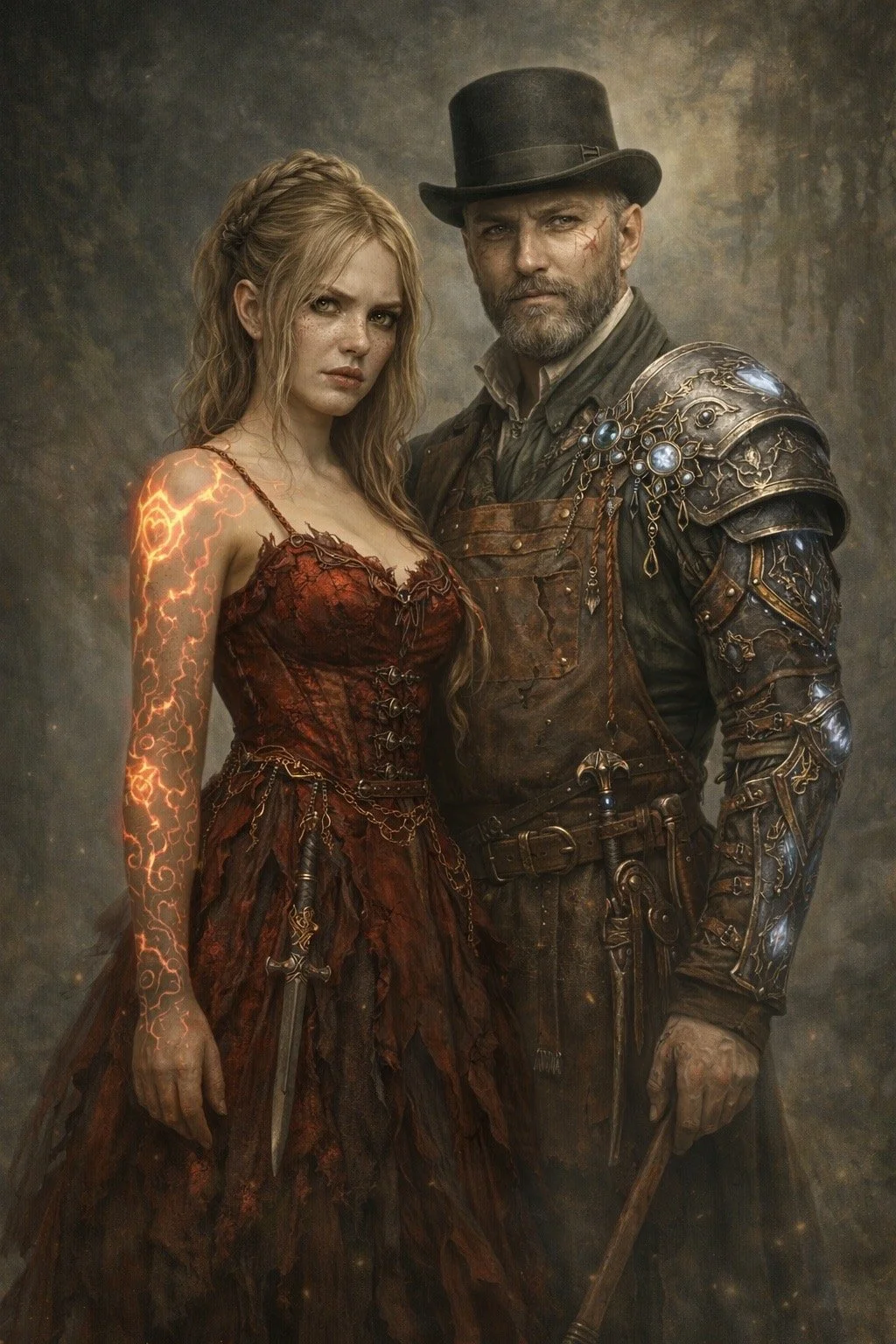
Their stories are entwined, as is the future of mortal and fae realms. It is only fitting that our archives record their histories together…
A CHILD OF THE WANING LIGHT
Victrannen, as she was known then, was not born into the radiant ages of fae power… but into the quiet dusk that preceded the Diminishing. She came into the world small, bright, and loud; her laughter echoing like bells through Tiraelun’s groves, her temper flashing like sparks.
Where her older sister Branna carried the gravity of an eldest-child, Victrannen was untamed emotion. She felt everything deeply – so deeply, in fact – that her hair became an extension of her inner world: bright silvery-gold when joyful, burnished copper when distressed, and a dull rose when afraid.
It made her beloved by some, exhausting to others, and utterly impossible to ignore. She was fiery, tempestuous, impulsive, brash; but never cruel. Her heart, even then, was soft. And all the while, her sister shielded her.
SHELTERED FROM THE DIMINISHING
As the Diminishing swept through Tír na Skiva – elders fading like dying constellations – Victrannen remained untouched by despair.
Unbeknownst to her, it was her elder sister who accepted the pain and sorrow for both of them.
The future Willow Queen, not yet crowned, drew grief into herself like stormwater into a reservoir. She bore the weight of fading magic, unraveling certainty, and the terror that hollowed their people. Victrannen never felt it.
She saw things dim, but never dark. She saw fae vanish, but never understood true loss. She lived in a curated childhood of illusions and gentleness, love wrapped around her like moss around a stone. Because of Branna she grew up knowing an imperfect world, but never knowing true sorrow. And this would become the wound between them.
THE SHATTERING & THE FALL INTO MORTALITY
When a storm of grief finally tore the Veil apart, Victrannen was swept helplessly into the mortal realm. She awoke on the outskirts of a small village: disoriented, frightened, and appearing, to mortal eyes, as a young teenager. Without her sister’s sheltering magic, the world struck her with its full weight: cold air, piercing hunger, the smell of iron, and the fragility of the beings around her.
The villagers found her wandering alone and took her in and she accepted their help feeling no other choice… and because mortals, with their earnest clumsiness, disarmed her.
She hid her hair’s magic as best she could, hid what she was, and learned to survive. And in time, she learned to love them.
THE WAR THAT GAVE HER NAME
Years passed. Victrannen – still unnamed in mortal terms – raised crops with them, tended wounds, and sat beside hearths listening to stories where fae were the tricksters and omens of legend.
But then came war. A conflict of Kings swept across the land, rival factions clashed, and one violent force descended upon her village. The villagers hid her, thinking she was still just a child, but when the walls burned and people she loved fell screaming into the trodden earth, something ancient in her rose.
Her hair flared like molten copper and seizing a fallen sword, she brought it to bear against her foes with fae-swift reflexes.
She was brutal, she was swift – and in the melee, mortals twice her size fell before her. She defended the helpless, rallied the terrified, and held back the tide long enough for survivors to flee.
The battle was ugly, bloody, and traumatic, and became her first true encounter with mortality.
When dawn broke and the dead were counted, the villagers gathered around her… not with fear, but reverence. They told her she brought victory – and so named her Victoria – the mortal translation of her true name’s core: the one who triumphs.
Victoria accepted it, allowing it to settle around her like armor, and it became her rebirth. And Victrannen – the sheltered child of the fae realm – began to fade behind her.
THE WEIGHT OF MORTAL LIVES
Victoria remained with the village for decades; long after any of her first companions had aged, married, borne children, grew old, and died.
She tended the wounded, mourned at every funeral, grew to love again, then lose, again and again. Her heart, once protected by her sister’s sacrifice, broke open with each passing year.
Mortals lived too quickly.
Mortals died too easily.
Mortals suffered without magic to dull the edges.
She could not understand how humans bore it, and yet she also could not turn away from them. Her innocence collapsed under the weight of their grief, and it nearly destroyed her.
SISTERS REUNITED
Stories spread of a radiant young woman whose hair changed color with emotion; a girl who never aged, of a warrior who fought like a creature from legend.
The Willow Queen, as she was now called, followed these tales until they led her to the truth. But when they met again, Victoria did not run into her arms, instead she turned away. She demanded from her sister what right had she to shield her from pain, only to allow her to be cast into a world made entirely of it. And when The Willow Queen tried to explain she had done so out of love, Victoria only felt resentment for it.
And so, though the bitterness softened over the centuries, it never vanished. Their bond remained braided with hurt and love – unbreakable, but imperfect.
THE WANDERING YEARS
Victoria did not take her place at her sister’s side for long. Feeling out of place in the intricate diplomacy of courtly life, she found herself instead, wandering once more. She fought in wars mortals would forget, guarded caravans through blizzards and sandstorms, sheltered the oppressed, defended the hunted, and waged quiet battles in shadowed places.
In some realms she was a rumor. In others, a ghost. But to many, a guardian.
Her hair flashed copper in the heat of combat, gold when she saved a life, rose when she mourned yet another mortal who slipped away too soon. And as the world grew more “civilized,” her sword was less needed. The battles faded. Oppression changed faces: grew more subtle, more insidious. And Victoria – blade without a battlefield – returned to the Willow Queen’s court with restlessness in her bones.
She smiled. She danced. She laughed too loudly; hiding a warrior’s loneliness beneath a jubilant mask. And waited for something she could not name.
THE BUTTERFLY AND THE METALSINGER
She did not expect purpose to appear in the form of a mortal blacksmith.
When a crate fell in the marketplace and butterflies burst into the air, Victoria’s laughter rang like sunlight on glass. Wesley Hartwell looked up, and for a moment, their eyes met.
Victoria felt something shift. Not fate… Not magic… Something quieter.
Here was a mortal who carried metal like it was a friend, not a weapon. Here was a man whose craft sang in a way she had never heard. Here was stillness – honest, steady, grounding, stillness – meeting her restlessness without flinching.
And when he sent her a gift of a mechanical butterfly, without any perceived motivation, she sought him out. She told herself it was only curiosity and admiration for his strange gift; She told herself many things. None were true.
And when she almost lost him, finding him beaten and broken by a rogue human faction, barely clinging to life, she felt the world narrowing into terror, her magic tearing free in copper-coloured fury. She shattered chains, split wood, and dragged him from death with trembling hands.
Only then did she understand what centuries had withheld from her. Love: but not the fleeting love of mortals she had grieved in ages past, but the enduring, all-consuming kind she had never known was possible.
FINDING HER PLACE
She now stands at the Willow Queen’s side not just as a princess, not as a diplomat, but as herself: a warrior forged by mortal years, a protector shaped by loss, a woman who has lived too long and loved too deeply to pretend at lightness forever.
Her hair still shifts with feeling, her spirit is still tempest and dawn, and Wesley – quiet, steadfast Wesley – is the first soul who has ever steadied the flame without extinguishing it.
Where she is fire, he is dawn. Where she is metal, he is the anvil that molds it. And together they walk into an age where mortals and fae may yet choose each other: not through treaties, not through war, but through the love that bridges worlds.
There was nothing remarkable about the street where Wesley Hartwell was born. Smoke clung to the chimneys like old sorrow, and the clatter of hammer on iron was the lullaby of every child raised behind the forges. His father was a blacksmith: broad-shouldered, quiet, worn down by years of heat and hunger. Wesley grew up watching that slow erosion, the cracked hands, the blackened nails, the soot that never washed out of their clothes, or their lives.
He did not hate the forge. He hated what it did to his father.
And in those days, he dreamed of anything else.
The Night Market and the Metalsinger
When Wesley was twelve, fate – or perhaps something gentler – intervened.
He lingered too long chasing a feather drifting on the breeze, and before he realized, dusk had closed around him like a curtain. The streets twisted strangely; unfamiliar though he had walked them a hundred times. As he turned a corner, lantern light shimmered in impossible colors and the air filled with scents he had no name for. He had wandered into the Night Market of the fae.
Humans told stories of it: a wandering marketplace that slipped in and out of mortal alleys, impossible to find unless it wished to be found. Wesley stood rooted, breath stolen by the glow of floating lights, by merchants whose eyes glimmered like frost and fire, and wares that hummed softly with their own life.
Then he heard it: the ringing of metal. But not in the harsh rhythm of mortal smithing; it was a fluid, living cadence… as if the metal itself were singing back.
Drawn like iron to a magnet, he approached a fae forge. There, he found Aeraleth, the Téarach – a fae metalsinger – shaping steel through both hammer and melody. The metal on his anvil did not merely soften; it moved… curled, and unfurled as though dancing to the tune he hummed. Wesley could not look away.
Aeraleth noticed the mortal child and beckoned him closer. “Metal likes courage,” he said, offering Wesley the hammer.
Wesley took it, and without understanding why, he began to hum the same melody Aeraleth had been singing; a song he had never heard, yet seemed to know by heart.
The metal responded: it lifted and flowed beneath his hand like quicksilver awakened.
Aeraleth stared in astonishment. A mortal child should not have known the forging-song of the Téarach. And yet Wesley voiced it instinctively, as if singing to metal were as natural as breathing.
From that night forward, whenever the Night Market visited the mortal realm, Wesley Hartwell found his way to Aeraleth’s forge. He learned the old songs, and they in turn provided him with a newfound love of the forge, and appreciation for his father’s work.
His father, for his part, never questioned the boy’s growing skill. And soon enough, the forge that had once broken his father’s body, became the foundation of Wesley’s rising craft.
Master of a New Age
By the time he reached young adulthood, Wesley had taken over the family forge altogether. His creations were unlike anything mortals had seen; more delicate, more resilient, more strong… and his Clockwork creatures – sparrows, foxes, dragonflies – moved with such a flawless grace that even fae engineers took interest.
Clients from both realms sought him out, and apprentices with the rare ear for metalsong flocked to his workshop. And Wesley, without ever meaning to, became one of the most renowned craftsmasters of the city.
But success demanded something he had not expected: he spent more time signing documents than holding a hammer, more time approving shipments than shaping metal. He missed the forge. He missed the music. And most of all, he missed the feeling that metal itself was listening.
And then came the morning that changed everything.
A Glimpse of Silver-Gold
While overseeing crates bound for the Willow Queen’s court, a box slipped from a wagon and crashed into a garden. Butterflies scattered, wings flashing in a frenzy of iridescent color. Wesley turned… and saw her.
A young fae woman laughing among the fluttering insects, her silver-gold hair catching the sun, her smile bright as starlight. For a heartbeat, he stood rooted, breath caught in his chest. She moved through the crowd with an effortless grace that seemed to slow the world around her.
Then she was gone; disappearing into the throng of morning shoppers.
It should have been nothing more than a moment, a shimmer of beauty that faded like perfume on the air. But destiny had other ideas, and not more than a week later he saw her again, walking arm in arm with the Willow Queen herself. Their gazes met. She smiled at him, soft, curious, unexpected. He discovered she was Victoria; younger sister to the Queen.
Wesley despaired. A mortal blacksmith could no more win the heart of a fae noblewoman than a candle could capture the moon; but he could not forget her. So he returned to the forge – his refuge – and crafted the most delicate thing he had ever made: a mechanical butterfly, wings of silver-gold, able to flutter through intricate gears and powered by metalsong.
He sent it with a note, daring not to hope. To his utter amazement, she accepted the gift, and the next day, she stood in his doorway, radiant and smiling. It was the beginning of something neither yet understood.
The Ember-Lit Courtship
Mortals like to tell stories of love that flares bright and vanishes quickly: a flash in the pan. But some loves burn differently: slow, steady, patient… as embers that gather heat until the world notices their glow. Wesley’s love was of the latter kind.
He loved Victoria from the moment he saw her, but hid it gently; knowing how foolish it was for a mortal to long for one such as her.
At first Victoria returned to the forge with supposed errands and questions from court, her laughter bright, her presence disarming. As her visits became more frequent, she dropped any pretense of being sent on her sister’s behalf.
Yet Wesley could never tell whether she came out of kindness, fascination, or something deeper. Fae affections were unpredictable things, and he feared misreading every smile. Ever still, she lingered near him; watching the way he coaxed metal into elegance, studying his clockwork wonders, sitting shoulder to shoulder with him as he worked.
He treasured those moments, even as he wondered what they meant. Was he a novelty to her? A friend? Or something more? He did not dare to ask, and instead Wesley Hartwell loved her with patience.
The Abduction
As Victoria’s visits grew more frequent, Wesley could know nothing of the quiet attachment forming in her heart. What began as curiosity had rooted itself in her as comfort, though even she had yet to understand the depth of it.
Not until the night she almost lost him.
A mortal extremist faction – those humans who despised fae presence in their city – had been watching Wesley, believing he possessed stolen Téarach secrets. One winter night they seized him, dragging him into a hidden warehouse where fae artifacts were dismantled in secret, with the intention of pulling those secrets from him; with force, if necessary.
When Victoria arrived at the forge that evening and found it in disarray; dark, and silent – and sensing something was very wrong – was immediately filled with dread. She searched the city throughout the night, her magic lashing uncontrolled, time trembling around her steps.
At dawn, she found him. The shackles imprisoning him shattered under her fury, the walls buckled, lanterns burst in showers of light. His captors fled in terror. Wesley, broken and barely conscious, saw her framed in the collapsing doorway: a vision of fire and fear and love unspoken.
He did not remember what she said. But he remembered her hands shaking as she pulled him close. And whatever lay unacknowledged between them became undeniable.
Sister to the Queen
Victoria had Wesley brought to the healers at the Willow Court, resolved to never leave his side again.
The Willow Queen, however, knowing both the fragility of mortal life and the volatility of her court, feared that her sister’s attachment to a human could ignite unrest among those already wary of mortal-fae entanglements. She wished to shield Victoria not only from the inevitable heartbreak of loving one whose life would pass in a blink of decades, but also from the turmoil such a union might provoke.
Yet when she saw the sincerity in Victoria’s devotion – its depth, its clarity – she understood that her sister’s choice had already been made. Victoria, steadfast in her resolve, made her sister understand that some joys were worth their cost, and thateven a fleeting span of love, she believed, held greater worth than an eternity untouched by it.
It was this unwavering conviction that ultimately guided the Queen’s decision, and though the weight of consequence settled heavily upon her, she chose not to stand in her sister’s way.
Devotion and the Present Day
Wesley healed slowly, but after that night, he was never alone. Victoria remained close, not with excuses or ceremony, but with intention; their lives intertwined like two metals forged in the same fire. She spent hours at his forge, admiring each new wonder he coaxed from steel and song. He in turn accompanied her to court, awkward but earnest – bowing too deeply or not enough – though always with a sincerity that endeared him to many. They walked the city at dusk, escaping to the Night Market at every opportunity; and shared quiet mornings where neither needed to speak.
From the outside, their closeness looked effortless; a bond strengthened by trial, and sustained by choice.
Over time whispers of scandal faded into whispers of possibility, and their love became a symbol of unity that even the Willow Queen herself could not ignore.
And now, as the Faelight Ball approaches, Wesley and Victoria Hartwell stand not merely as lovers, but as proof that a bridge between realms is possible: a love forged slowly, strengthened by fire, and enduring as tempered steel.