

Finskel, the Elder Hidden in the Dark
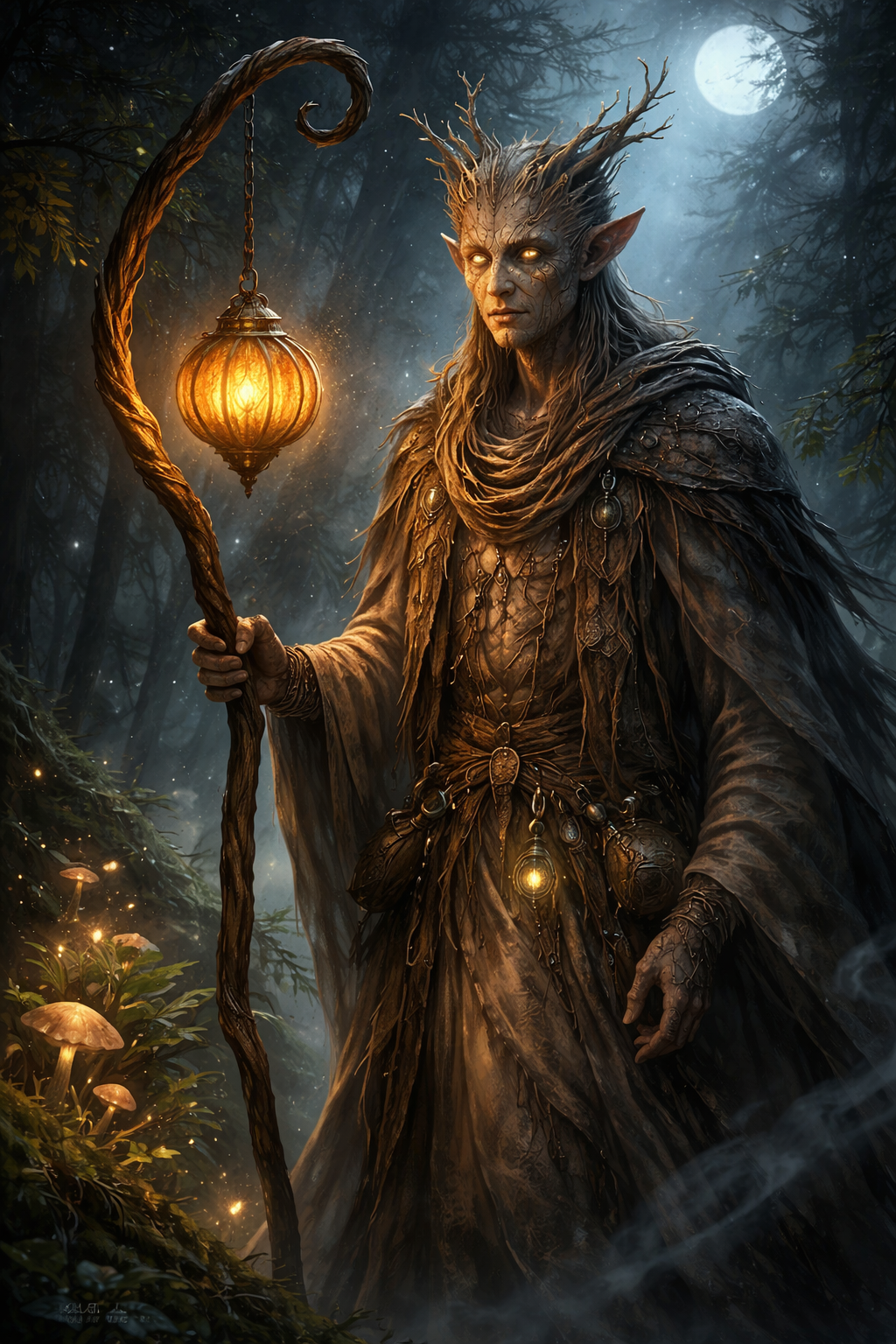
A Child Born Beneath the First Night
Soft songs stirred through the grass the night he opened his eyes.
The world was still new then, the air tasting of starlight, the soil humming with first breath. The skies above him churned in brilliant swirls as if the universe itself rejoiced at his awakening. It was rare for a fae to be born in the dead of night, and in the earliest of ages, some even whispered that such births were cursed… destined for shadow, mystery, and solitude. But this birth was different.
It is said that each time one of the elder fae were born, a single radiant light would cut across the heavens, to find its place as one of the countless stars that illuminate the night sky. On the night Finskel was born, that same light stretch across the sky, but before finding its final resting place, it paused above the field where he lay… sinking into his newly opened eyes. It paused there for a moment, only to then fly upward again, settling into the sky… but this time, it was different; larger and more luminous than the rest, and from it, say the fae, the moon was born.
Thus was named Finskel: the Watcher, the Guardian, the one who gifted light to the darkest hours.
He grew among the eldest, watching them shape the nascent world: conjuring oceans, sculpting forests, coaxing song from stone and feather from wind. While others built and forged, Finskel watched – and recorded. He wrote down every spark of magic, every early truth, forgetting nothing.
And then at night, while the others slumbered, he painted the heavens: bright constellations, ribbons of color, and dancing stars that told forgotten histories. The fae began calling him The Farron of the Moon, the one whose joy embroidered the night.
As ages passed he bottled magic, studied it, and slowly transformed it. He was the first alchemist, the first archivist, and the first to understand that magic was a memory made manifest… and memories must be preserved.
The Veils and the Children of Dream
Wherever the border between both fae and mortal realms thinned, where mist pooled like morning breath, both mortals and fae alike called those liminal places the Veils. In the earliest days they were soft and shifting; porous as woven thread. Finskel himself named them the Dreams, for through them, wanderers often crossed without intention.
Mortals – most of all their children – drifted through the Dreams with trusting hearts. Some stayed moments, others stayed lifetimes.
In the mortal realm, tales spread of children lost to forest spirits. On the fae side, those same children were welcomed as gifts: bringers of vitality, imagination, and precious fleeting life.
Finskel loved them, these visitors of brief and brilliant fire. He traded their stories for lights in the sky and wrote their every tale into his books and constellations. Their innocence warmed him in ways that fae magic never had.
Then, one night, a child did not wander into Finskel’s realm: he was left.
A small human boy laid at the very edge of the Veil, wrapped in a blanket, abandoned between worlds; unwanted by one realm, forbidden to the other.
The laws were strict: mortals may cross over on their own, or without intent, but they must never, ever, be brought. Despite the wild stories mortals told at fireside, the fae themselves knew to never intervene: it was forbidden. But Finskel had already begun to understand a deeper truth: mortals were a source of vitality, of inspiration, of life itself. And this boy, fragile and fading, called to him like a dying star.
Finskel broke the law. He swaddled the child and fled into the great forest of Scáihain, dimming the moon itself so no one would see.
He named the boy Zauber. He hid the child’s ears beneath cloth until his hair grew long enough to disguise the missing fae tips, and brewed potions to heal mortal bruises. Years passed in quiet companionship, though to Finskel, years were droplets in a river. And Zauber for his part, aged far too quickly.
Fearing discovery, Finskel took his millennia of magic and alchemy knowledge to create his greatest work, calling on the fire-sprites to forge a magic ring that slowed the boy’s aging. It became the culmination of his life’s great work. For as soon as Zauber slipped on the ring, mortal time softened around him like warm wax, and his body ceased to age. They continued to live discreetly, appearing only at night, and bound by affection, secrecy, and the knowledge that their bond was forbidden.
The First Fading
The unraveling of the Veils marked the first true wound in the world of the fae. The air grew cold. The stars dimmed. The moon lost its shimmer. And magic wilted like a frostbitten bloom.
Finskel felt it before any elder spoke of it. He felt it in his bones… the ancient bones of the elder starborn. And when the first star dimmed to nothingness and along with it, the elder who had birthed it, he collapsed to the earth, gripping lifeless roots that had never known such silence before.
One elder disappeared. Then another. Whispers of disease spread… a slow, creeping erosion of being.
The elder council disbanded, each departing alone so their memories might remain intact a little longer, for the Diminishing consumed clusters faster than solitary souls.
Finskel wandered the forests with Zauber hidden at his side, writing every symptom, every vanishing, every fracture in the world. He too, expected to fade soon
Then came Branna.
A young fae woman wandering within Tiraelun’s ancient groves – not yet queen, not yet carrying the grief that would one day reshape worlds. Drawn by instinct or destiny, she found the hidden elder and the mysterious “fae” who lived beside him.
Finskel shared the earliest histories with her: the first dawn, the starbirth, the old magics. She listened, not with awe, but with reverence. This alone made him trust her.
She petitioned for him to join her as an Alchemist-Historian, the keeper of truths.
He agreed — but only if Zauber was allowed a place beside him.
She accepted. And when they left the forest, the clearing behind them dissolved into a black fog, as though memory itself recoiled from being seen.
The Shattering
Hopelessness gnawed at him.
Even Branna, now a rising leader among the fae, could not escape despair.
Finskel chronicled every pang of the Diminishing: hers, his own, and most of all, Zauber’s fear of losing him. He grew thin, pale, translucent. Starborn magic flickered within him like an ember struggling for breath.
Then the sky ruptured.
Black storm clouds rolled across the heavens, darker than any night since creation. The moon itself began to fade, its last light flickering like a drowning star.
Finskel lifted a lantern – a simple thing, a token of one of the lost elders – and called to the moon.
Not in command, but in longing
The moon answered. Its light plunged into the lantern, sealing itself away just as the world shattered around him. Then all went dark.
He did not know how much time has passed, but when he awoke, it was on unfamiliar soil.
Zauber knelt beside him.
They were no longer in the fae realm.
They were in the mortal world – a world he had only glimpsed of through drifting children and distant dreams.
The Shattering was complete.
The Veil was gone.
With moonlit lantern in hand, he sought the surviving fae.
He found them: scattered, frightened, diminished shadows of their former selves.
But alive.
A New Realm, and the Silence That Follows
Life in the mortal world required caution. Finskel obeyed the moral and legal boundaries only out of respect for Branna, who had risen into the mantle of the Willow Queen.
Still, he could not forget: it was mortal fear that once closed the Veils… and mortal absence that had starved fae magic.
He watched.
He recorded.
He learned.
In time, mortals sought him out – the eccentric scholar who knew impossible things; the healer with moonlit tonics; the wandering historian whose words carried the weight of ages. Even here, they called him Farron of the Moon.
But he never forgot what he saw:
Mortals killing for greed.
Mortals creating hierarchies out of coin.
Mortals who feared the fae enough to slaughter them.
Nor did he forget:
Mortals who had saved him.
Mortals whose stories kept the stars alive.
Mortals who breathed vitality into dying magic.
His own life was proof of the contradiction.
As tensions mounted between the realms, Finskel grew quieter.
He refused to take sides — not yet.
He merely wrote.
And waited.
The Faelight Ball
Now, at the brink of alliance, he stands again beside Branna — older than memory, carrying the last light of the moon, watching both realms with patient scrutiny.
If the Willow Queen calls for unity, he will support her.
But if she falters…
If the mortals choose fear over connection…
If the fae turn inward toward old wounds…
Then Finskel will reveal the greatest truth no one has yet dared to speak:
Mortals carry a magic the fae need.
And without it, the fae will one day fade altogether.
He hopes the night ends in peace.
He hopes the worlds choose each other.
Because if they do not, the secret bond he has kept for centuries – the mortal man who walks beside him through time – may be the match that sets both realms aflame.