

The Waters Between Worlds
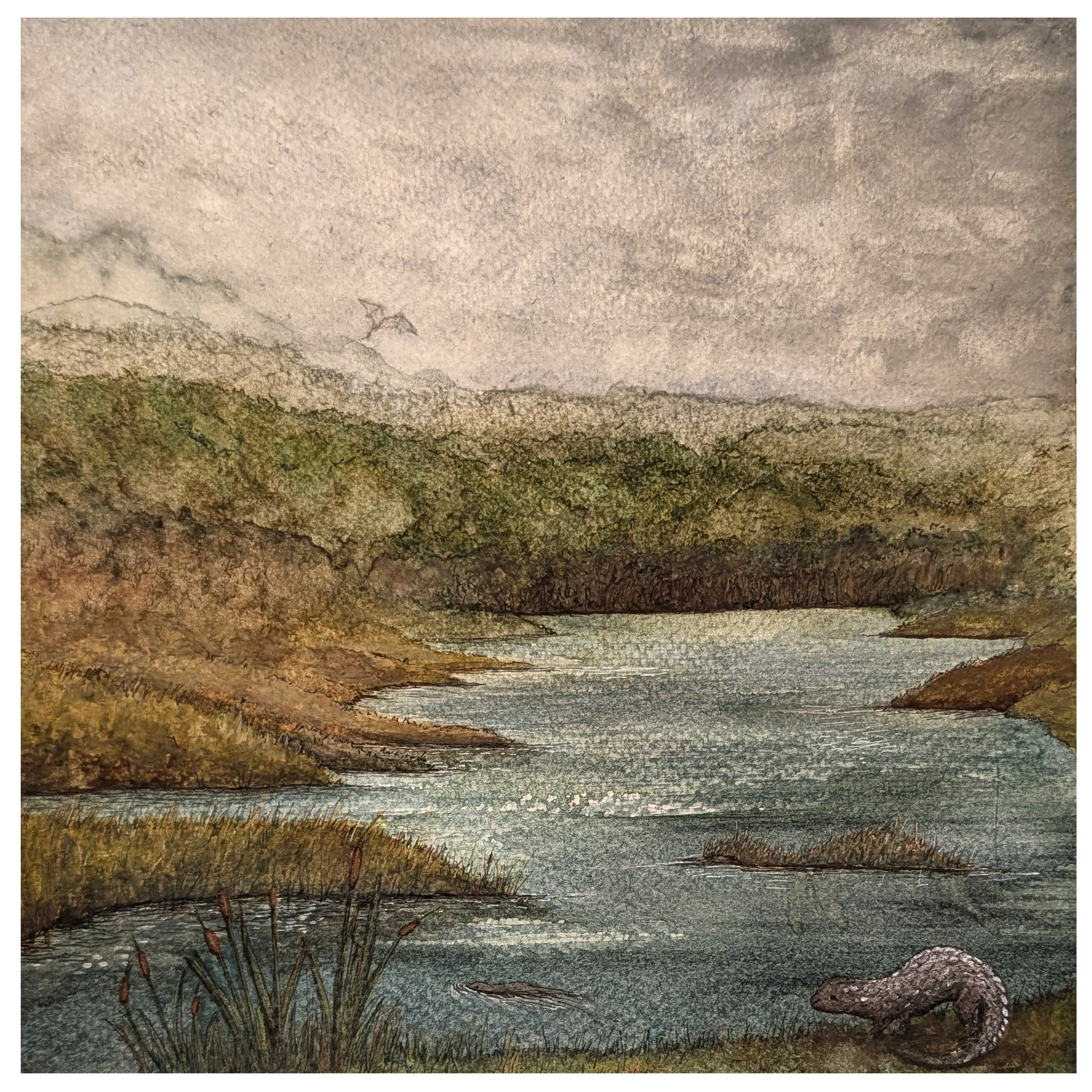
Collected and Recorded by Lucien Harow, Fellow of the Royal Society of Antiquities
Thoughout my research, I’ve discovered there are particular places within the surviving accounts of Tir na Skiva that resist certainty so completely, that one begins to suspect certainty itself was unwelcome there.
The liminal waters of Móirin appear to be one such place, and I have now abandoned any hope of drawing accurate borders around it. Indeed, after interviewing no fewer than fourteen separate fae regarding its location, I have received fourteen contradictory answers, two arguments, one visible shudder, and, from a particularly ancient healer, the recommendation that I “stop trying to pin mist to paper.”
I begin to suspect this was not metaphorical advice.
And yet before one reaches Móirin, nearly every account passes first through Isciún: the great inland waters of the eastern lowlands. Compared to the forests or mountains, Isciún is described with remarkable gentleness, relief even.
One account called it:
“The first place the land became willing to actively listen, instead of to simply remember.”
I confess I did not understand this statement until much later.
Isciún appears throughout fae recollection as a place of gathering, rather than destination. A vast freshwater body scattered with hundreds of islands; some little more than reeds and moss rising from the surface, others large enough to cradle temporary groves and seasonal settlements.
Notably, however, was the absence of any permanent settlements… which is remarkable for any of the fae to have mentioned in the first place; given that was their preferred method of dwelling in the first place.
Structures raised along Isciún’s shores were often woven from reeds, floating timber, or living growth intended to last only a few seasons before quietly returning to the lake itself. One elderly boatwright seemed deeply amused when I asked whether this was due to flooding.
“No, Archivist,” he said. “It was due to wisdom.”
Travel upon Isciún was apparently deliberate almost to the point of ritual. Several accounts insist haste upon the water was considered vaguely disrespectful, though none could satisfactorily explain to whom. The lake? The spirits within it? Time itself?
The answers varied, as they always do.
What remains strangely consistent is the emotional tone with which Isciún is remembered. Even fae otherwise reluctant to speak of Tir na Skiva became unexpectedly calm while describing it. One former attendant of the Willow Court paused midway through our conversation simply to watch rain gathering against the windows before remarking:
“The water there never interrupted your thoughts. It waited for them.”
I have found no mortal equivalent for this sensation.
The physical descriptions are beautiful enough in their own right. Irregular shorelines folding inward into quiet coves. Marsh grasses whispering at the water’s edge. Islands scattered across the lake like fragments of unfinished thought. Dawn and dusk reportedly transformed the entire surface into something brighter than the sky itself, as though the water gathered light rather than merely reflecting it.
But it is the magical behavior of Isciún that interests me most.
Unlike the volatile shimmer magic often associated with the fae, magic upon the waters reportedly settled rather than surged. Spells became calmer there, as if its intentions clarified. Several accounts suggest enchantments cast upon Isciún revealed truth more readily than illusion.
I have often hear it described this way:
“The lake did not make magic stronger. It made it honest.”
A dangerous quality, I should think.
Quiet councils were often held upon the islands, exchanges of knowledge, and reconciliations. Rites marking the passage from one life stage to another were ofteen considered sacred upon the shores, and the fae speak of the lake almost as one might speak of a patient confidant.
Among them it is said:
“What is brought to Isciún will not be rushed… and it will not be lost.”
I wonder if this is why so many displaced fae continue settling near lakes and riverlands even now, centuries after the Shattering. Some instinct, perhaps, carried forward from a homeland they no longer possess.
But eastward from Isciún, the stories begin to loosen… quite literally. Móirin. The Soft Lands. Or, in one particularly unsettling translation I encountered: The Mooring That Does Not Hold.
If Isciún gathered, Móirin released.
The region is consistently described not as hostile but indifferent, in a way that appears to deeply disturb even the fae themselves. Broad expanses of moorland and bog where mist flattened distance, and the horizon rarely remained certain for long. Water moved beneath the earth constantly, shifting the ground underfoot subtly, until land and reflection became difficult to distinguish.
One wandering herbalist told me:
“Móirin was never empty. It simply stopped insisting you were there.”
I am not too proud to admit I may have lost several nights sleep after hearing this, though I cannot place my finger on why it unsettled me so. For unlike the forests which listened, or the mountains which endured, Móirin appears to have possessed no recognizable emotional character at all. It neither welcomed nor resisted travelers. It merely continued changing around them.
Names reportedly became difficult to remember there, paths dissolved behind those walking them. Conversations wandered strangely, and several fae admitted to entering the moors in groups and emerging uncertain whether everyone who returned had originally entered at all.
I laughed when first told this, though no one laughed with me.
As much as I can surmise, the fae associate Móirin strongly with the thinning of the Veil. Not the dramatic rupturing of the Shattering, but smaller instabilities long preceding it… places where reality itself loosened softly at the edges, and have always, from time immemorial.
“In many places, our realms touched, or crossed into one another, sometimes for days, sometimes for a mere moment. We used those crossings as they were still dependable, deliberate. In Móirin, they forgot they were separate entirely.”
This, I suspect, is why the region remains so poorly documented, even among the fae themselves. Magic reportedly behaved abominably there, as if it had a mind of its own. Spells drifted incomplete or returned altered, and in particular, attempts at binding or permanence failed almost immediately.
Several spirits and water-bound beings are said to have dwelled comfortably within the moors, but few others lingered willingly.
One merchant I spoke to offered perhaps the clearest warning I encountered:
“Do not ask Móirin to guide you. It does not know where it is, either.”
As I write, I have begun to notice something peculiar while compiling these records. The further one travels, in memory, at least, from the heartwoods and mountains of Tir na Skiva, the less stable the world itself appears to become. Forests listen. Stone endures. Water reflects. Until eventually, somewhere beyond the mist and reeds of Móirin, even certainty itself begins to dissolve.
Perhaps this is merely mythology shaped by grief. Or perhaps, the fae realm was never meant to be understood in fixed terms at all. There are moments now, while reviewing these interviews late at night, when I catch myself wondering whether Tir na Skiva was truly even a place in the mortal sense of the word.
Or whether it was something stranger: a world held together by memory, intention, and belief until in a cataclism, it finally loosened its shape. If so, I fear we mortals may have inherited more than the fae intended when the Veil broke.
And I am no longer entirely certain the realms were ever as separate as we once believed.
— Lucien Harow
Harvest Season, 1871